
How Pest Control Eliminates Rats in Leeds Homes
Hearing scratching behind skirting boards at night, finding dark droppings in your kitchen, or spotting gnawed food packaging are strong indicators of rat activity. It is an unsettling situation — and one that is becoming increasingly frequent across Leeds.
Across the UK, rat activity has risen by 38% in recent years, with over 500,000 reports made to local councils between 2023 and 2025. Leeds, along with the wider West Yorkshire area, reflects this upward trend.
Densely populated areas such as Headingley, Chapeltown, Beeston, and Harehills experience particularly high levels of activity. Around 70% of infestations in Leeds are linked to drainage defects — including damaged or uncapped pipes that provide rats with direct access from sewer systems into homes. Activity tends to peak between October and February, when rats move indoors in search of warmth and food.

Professional pest control reliably resolves rat infestations — when the process is followed correctly. This guide explains exactly how.
Indications That Your Home Has Rats
Before arranging pest control, it is important to recognise what you are dealing with. The brown rat (Rattus norvegicus) is the most frequently encountered species in UK households. Typical signs include:
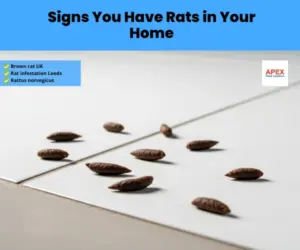
• Droppings — Dark, capsule-shaped, approximately 12mm long. Look along walls, under kitchen units, and near food storage.
• Gnaw marks — Fresh marks are pale and rough, often found on wood, plastic, and electrical cables.
• Grease marks — Oils in rat fur leave dark smears along walls and skirting boards at floor level.
• Sounds at night — Scratching, scurrying, or squeaking from ceilings, walls, or beneath floorboards. Rats are primarily nocturnal.
• Nests — Shredded insulation, paper, or fabric gathered in hidden locations: loft spaces, under appliances, behind cavity walls.
• Strong ammonia odour — Persistent smell of rat urine in a confined area.
• Burrows — Holes approximately 7–9 cm in diameter in the garden, near compost heaps, sheds, or decking.
If two or more of these indicators are present, an infestation is highly likely. Immediate action is recommended — a single breeding pair can produce up to 2,000 offspring within a year under favourable conditions.
The Professional Approach to Rat Removal
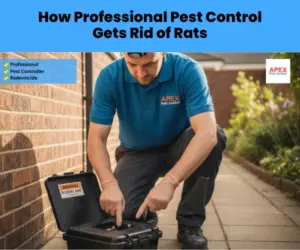
Effective rat control involves more than simply placing bait. A qualified technician follows a structured method designed to remove the infestation and address the root causes.
Step 1: Survey and Inspection
The initial visit includes a comprehensive inspection of the property — both internal and external areas — along with all potential entry points. Rats can pass through openings as small as 2 cm, making identification of access routes essential.
Step 2: Treatment Plan
Following the inspection, the technician outlines the recommended treatment plan. In most Leeds homes, this involves rodenticide bait stations, trapping methods, or a combination of both.
Step 3: Rodenticide Treatment — Bait Stations
Professional rodenticide treatment remains the most effective method of controlling rat populations. There are two key reasons why professional-grade products outperform retail alternatives.
| Source | Relevance | |
|---|---|---|
| 74% of UK brown rats carry resistance to first-generation anticoagulants | CRRU / Campaign for Responsible Rodenticide Use | Why supermarket bait fails |
| 518,240 rat reports to UK councils (2023–2025) | Inkl analysis / regional councils | Scale of UK rat problem |
| 38% rise in rat activity nationally | NPTA BBC Pest Activity Survey 2024–25 | Urgency / market context |
| 70 confirmed leptospirosis cases in England (2023); Yorkshire & Humber confirmed 2024 | UKHSA / UKPIKB — Disease node dis_leptospirosis | Health risk — local relevance |
| 28% rise in motor insurance claims from rodent damage (2024) | Aviva 2024 | Property damage risk |
| 3–6 weeks for standard domestic resolution | Shield Pest Control UK | Timeline expectation |
| Up to 2,000 descendants per pair per year | BPCA / entomological data | Urgency / act fast |
All bait stations used by Apex are tamper-resistant, clearly labelled, and installed in line with CRRU guidelines to protect children, pets, and non-target wildlife. Since January 2025, CRRU stewardship rules restrict the outdoor use of second-generation anticoagulant rodenticides (SGARs) to areas directly adjacent to buildings — making correct professional placement a regulatory requirement rather than optional best practice.
Step 4: Trapping
Snap traps may be used alongside or instead of rodenticides where bait cannot be safely applied, or where quicker results are required. When correctly positioned along active rat pathways and baited appropriately, trapping is highly effective. Glue traps are not used by professional pest control services.
Step 5: Follow-Up Visits
A single visit is rarely enough to fully resolve an infestation. Follow-up visits allow technicians to monitor bait uptake, adjust placements, and confirm that the rat population has been eliminated.
Step 6: Written Report and Proofing Advice
At the conclusion of treatment, Apex provides a detailed written report outlining findings, actions taken, and recommended preventative measures — including practical proofing advice to stop rats from returning.
Limitations of DIY Rat Control
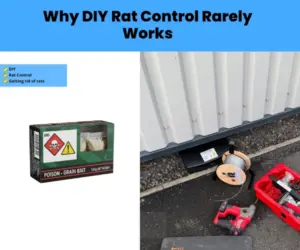
DIY products such as rodenticide blocks, snap traps, and ultrasonic deterrents are widely available, but their effectiveness is often limited for several reasons:
• Resistance is now widespread. Around three-quarters of UK brown rats carry genetic mutations (VKORC1) that make them resistant to first-generation anticoagulants. Resistance has been confirmed in Yorkshire brown rat populations specifically.
• Placement is a specialist skill. Without knowledge of rat runways and nesting areas, bait and traps are frequently placed in the wrong locations.
• Rat repellents do not work reliably. Ultrasonic devices have no credible evidence base and are not endorsed by the BPCA.
• Partial treatment makes things worse. Killing part of a colony without sealing entry points simply creates space for new rats to move in.
Professional pest control costs more than a trip to the hardware store — but it actually works. Apex offers fixed pricing with no call-out fee.
Health Risks of a Rat Infestation
• Leptospirosis (Weil’s Disease) — caused by Leptospira interrogans shed in rat urine. 70 confirmed cases in England in 2023; Yorkshire and Humber cases confirmed in 2024. Can cause liver and kidney failure if untreated.
• Salmonellosis — approximately 9,480 UK cases confirmed in 2023; rats spreading Salmonella enterica through droppings are a direct food safety risk.
• Hantavirus — spread via inhalation of aerosolized rat urine, droppings, or nesting material. Requires FFP3 mask and full PPE when clearing infested areas.
• E. coli O157:H7 and Listeria — transmitted via faecal contamination of food preparation surfaces; Listeria can grow at refrigeration temperatures.
• Structural damage — rats gnaw electrical cables (fire risk), insulation, pipework, and roofing materials.
• Legal duty — under the Prevention of Damage by Pests Act 1949, occupiers have a statutory duty to keep premises free from rats. Local authorities can compel action and carry out treatments if owners fail to comply.
Early intervention reduces both health risks and repair costs.
How much time does it take for pest control to eradicate rats?
For most domestic properties, a standard rat infestation can be resolved within 3 to 6 weeks using professional treatment. More severe infestations may take up to 3 months. During the initial survey, your Apex technician will provide a clear and realistic timeframe.
Preventing Rats After Treatment
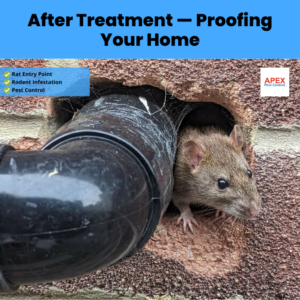
• Seal entry points — gaps around pipework, damaged air bricks, holes in walls, and gaps under external doors.
• Remove food sources — managed compost heaps, covered bins, no pet food left out overnight.
• Remove shelter — clear wood piles, rubble, and dense vegetation near the building.
• Address drainage — approximately 70% of Leeds rat infestations are linked to a drainage fault. A CCTV drain survey can identify broken or uncapped pipes that give rats direct access from the sewer network into your property.
Why Apex Pest Control Is a Trusted Choice in Leeds?
Apex Pest Control is a BPCA-certified and CHAS-registered company operating across Leeds and surrounding areas, including Horsforth, Morley, Roundhay, Pudsey, Garforth, and Wetherby.
| Credential | Detail |
|---|---|
| BPCA Certified | Every technician trained and assessed to BPCA standards — the recognised UK benchmark |
| CHAS Registered | Health & Safety accreditation — verified safe contractor |
| Fixed Pricing | Full cost confirmed before work starts. No call-out fee. No surprises. |
| 40+ Years Experience | Rats in every type of Leeds property — domestic, commercial, listed buildings |
| £5M Public Liability | Fully insured for domestic and commercial work throughout West Yorkshire |
| NPTA Member | National Pest Technicians Association — professional standards body |
Frequently Asked Questions
How does pest control get rid of rats in a house?
A professional pest controller surveys the property to identify entry points and active rat runs, then places tamper-resistant rodenticide bait stations along those runs. Follow-up visits check progress, replenish bait, and carry out proofing to prevent re-entry. Most domestic rat infestations are resolved within three to four weeks.
How long does it take pest control to get rid of rats?
For most domestic properties in Leeds, active rat activity reduces significantly within two weeks of treatment beginning. A full resolution typically takes three to four weeks. Severe infestations may take longer.
Is rat pest control safe for children and pets?
Yes. Apex Pest Control uses tamper-resistant bait stations that are locked and secured, preventing access by children, pets, and non-target wildlife. Bait is only accessible to rodents.
Can I get rid of rats myself?
DIY rat control is significantly less effective than professional treatment for established infestations. Glue traps — previously sold in DIY stores — are now banned for public use in England under the Glue Traps (Offences) Act 2022. Professional pest controllers identify entry points and harbouring areas that are not obvious, making professional treatment more reliable.
How much does rat pest control cost in Leeds?
Apex Pest Control charges a fixed price for domestic rat treatment in Leeds with no call-out fee and no hidden charges. Cost varies depending on the size of the property and the extent of the infestation. Call 0113 390 4270 for a clear, upfront quote.
Speak to a Rat Control Specialist Today
If the signs described above are familiar, arranging a professional survey is the most effective next step. Apex covers Leeds and surrounding areas — BPCA certified, fixed pricing, and no call-out fee.
Apex Pest Control Leeds · 0113 390 4270 · info@apex-pest-control.co.uk Covering: Leeds, Horsforth, Morley, Roundhay, Pudsey, Garforth, Wetherby
 Apex Pest Control